
The Network is under Pressure. The innovation isn’t coming from the network
Written by Darrell Taylor from ASKA
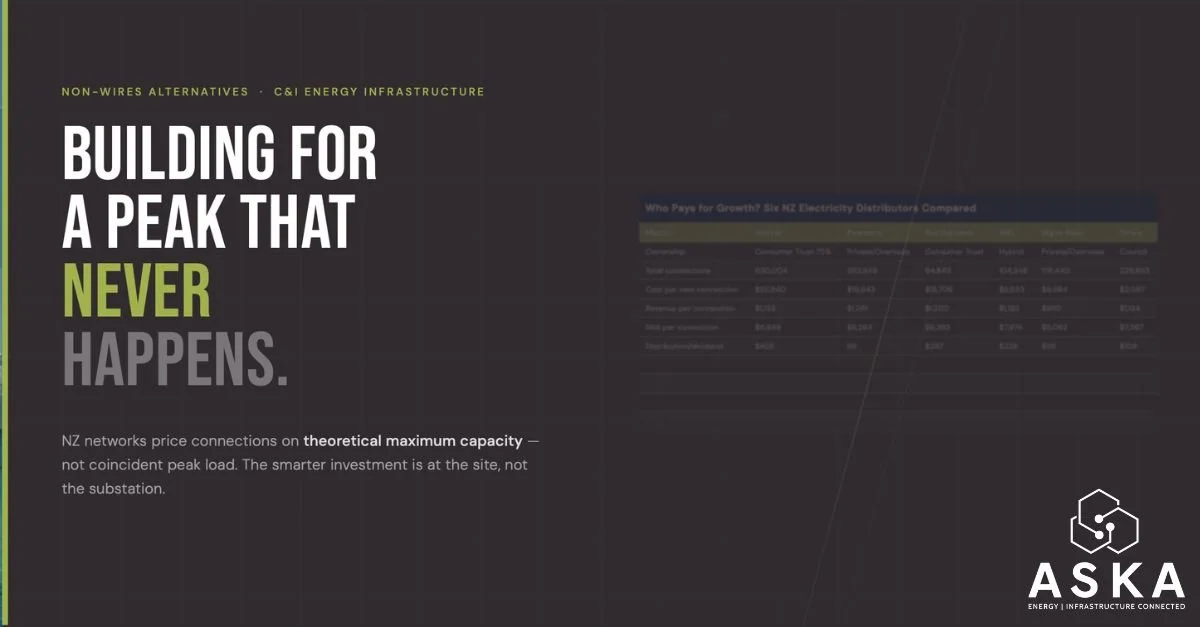
The network is under pressure. The innovation isn't coming from the network.
Jonathan Milne's piece in Newsroom this week is worth your time. So is Kirsty Merriman's LinkedIn post. Together they tell the same story from different angles.
Vector pays out more in dividends than it earns in net profit. Its developer capital contribution per new connection is $25,840. Orion's is $2,087. The Commerce Commission is signing off large lines charge increases under DPP4 to fund catch up investment. Those costs get pushed through to consumers and businesses.
That's it. That's the plan.
Pushing costs through isn't innovation it's inertia with a price tag.
Here's what frustrates me; Vector sizes network infrastructure and calculates developer contributions based on total connected site capacity. Not what the site actually draws. Not what all those sites draw simultaneously. Every heater, every motor, every charger running flat out at the same moment on the coldest peak evening of winter. That moment is the theoretical worst case. It's also almost certainly never happened and never will because loads don't coincide like that.
But we're building for it anyway, why do it that way that is old fashioned and expensive. And also charging every new connection as if they're personally responsible for it.
The smarter question is why we aren't investing in the tools that actually manage coincident peak at site level. A C&I customer with BESS can see that peak coming and respond to it within milliseconds. Shed load and dispatch storage. Reduce exactly the demand that drives network investment in the first place. That's not a future concept it's available now, we model for it and it works.
This is what non-wires alternatives actually look like in practice. Not a grid planning concept. A commercial decision made at site level with a business case built around what's actually available at that location. Multiple value streams. Real returns on Infrastructure that works for the site owner and the network at the same time.
To be clear Vector hasn't offered to fund it. The regulator hasn't mandated it. But EECA thankfully is now moving to support it. A genuine signal that the policy settings are starting to catch up with the commercial reality
At ASKA we're working in that space with C&I customers who are ready to stop waiting for the network to solve a problem the network has no real incentive to solve quickly. The resilience is there. The value streams are real. The thinking just has to get there first.
Worth reading both pieces below.
Newsroom : https://lnkd.in/eBxUWhi8
Kirsty: https://lnkd.in/e3S82H9F
EECA (Energy Efficiency and Conservation Authority) ASKA hashtag#BESS hashtag#NonWiresAlternatives hashtag#EnergyInfrastructure hashtag#NZEnergy hashtag#EnergyTransition hashtag#Flexibility hashtag#DemandManagement
